STEP 2 — Nietzsche
Exhaustion of Force

Exhaustion of Force
There is a particular kind of brilliance that burns too hot to last. You feel it immediately when stepping into Nietzsche’s world: everything is motion, voltage, intensity. Nothing rests; nothing is permitted to be still. The world becomes an arena where value must be wrestled into existence through sheer personal magnitude.
For a time, this feels like liberation.
It feels like a fresh climate after the collapse of old certainties.
Yet when one stands quietly—truly quietly—in the open field, the Nietzschean project reveals its deepest flaw. It requires constant combustion. Meaning must be generated again and again through effort, assertion, and force. There is no place to stand that does not depend on your next expenditure of energy.
The will-to-power never becomes a foundation.
It is a perpetual emergency.
In Nietzsche, orientation is replaced by momentum.
You move, therefore you exist.
You ascend, therefore you justify yourself.
You create, therefore your world is valid.
But a life that must justify itself at every moment through creative or heroic force is not oriented—it is strained. The great irony is that Nietzsche sought liberation from metaphysical burdens, but replaced them with the heaviest burden of all: the requirement that the individual secure meaning through performance, forever.
When force becomes the sole generator of value, rest becomes dangerous.
Stillness becomes suspicious.
Silence becomes defeat.
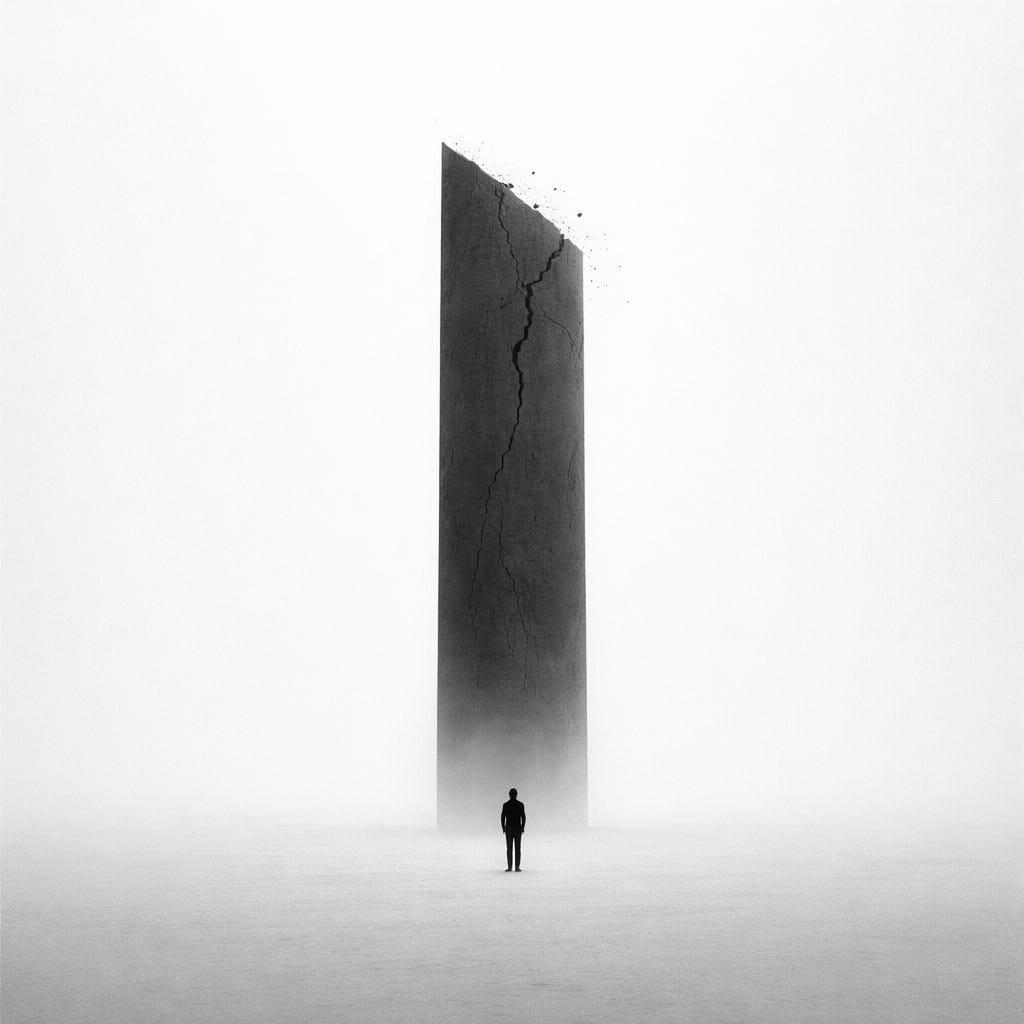
Against this background, the solitary figure in the field stands as Nietzsche’s opposite: upright without assertion, stable without performance, meaningful without self-invention. This stillness exposes the fragility of Nietzsche’s architecture. It shows how force exhausts itself. It shows that any structure built on perpetual intensity will eventually collapse by its own demand.
The dismantling is not dismissal.
Nietzsche identified something true: that inherited meaning had rotted and needed to be confronted. His diagnosis was piercing. His courage was real. But courage is not structure. Diagnosis is not direction.
His entire project remains suspended over the abyss it exposed. It names the problem but cannot step back from it. The abyss becomes a workplace, a gymnasium, a proving ground. You are asked to live at the edge—not to cross it, not to leave it behind, but to turn the edge into your only home.
This is a powerful pose.
It is not a livable architecture.
The force eventually fails.
The self-justification becomes weary.
The heroic stance becomes ritual.
And eventually, the thinker or reader collapses—not through defeat, but through simple depletion. It is not that Nietzsche is wrong; it is that he cannot rest.
A Hermit, Here
Dear Subscriber:
Dismantling the Nietzschean pillar reveals a deeper clarity:
If meaning must be generated by force, then meaning is always provisional.
If orientation must be invented, then orientation is always fragile.
If value depends on performance, then value dies the moment the performance ends.
The field demands something different: an axis, not a posture.
A structure, not a blaze.
A ground, not a gesture.
This is why Nietzsche stands first in the sequence.
Ahead lies the next structure to dismantle…