STEP 3 — Camus
The Closed Room of the Absurd

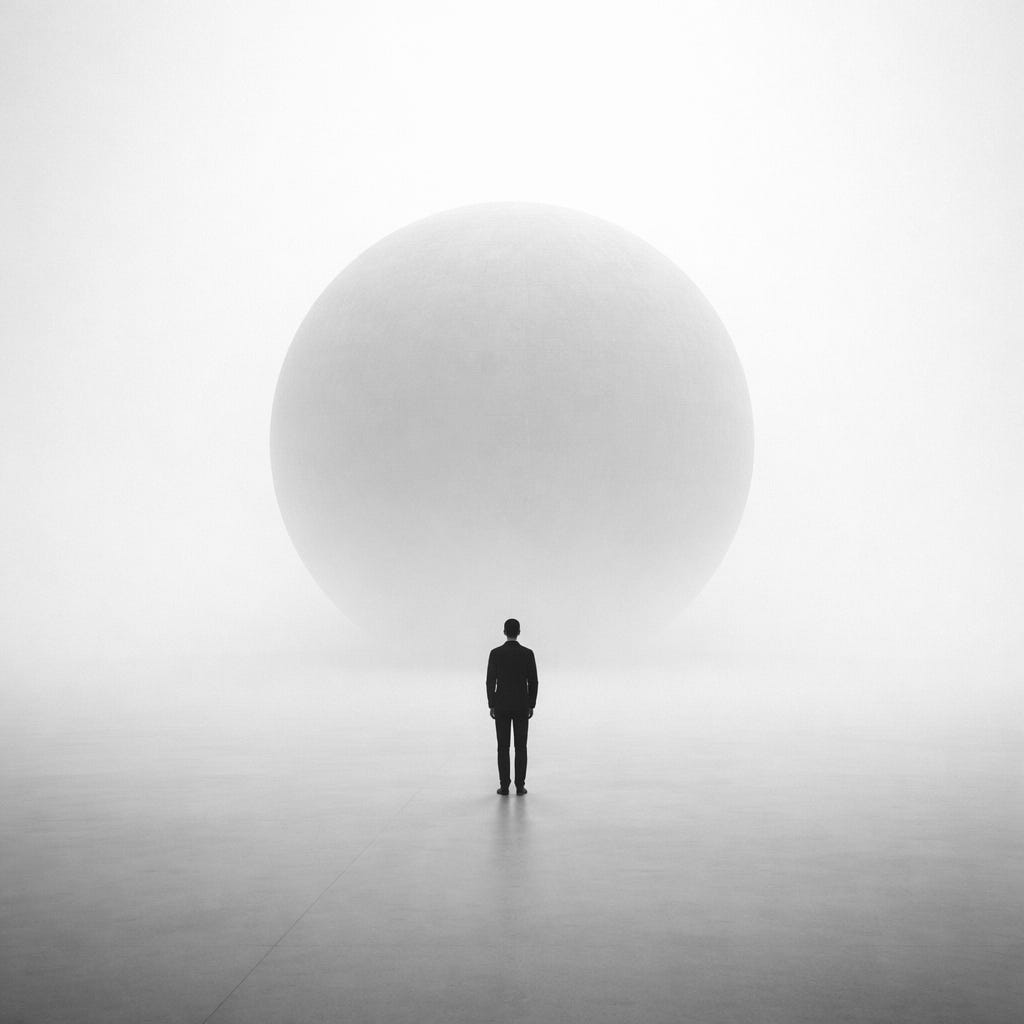
The Closed Room of the Absurd
If Nietzsche burned, Camus endures.
Where force exhausts itself in brilliance, Camus steadies himself in restraint. The blaze becomes a quiet flame. The grand gesture becomes a refusal. Instead of inventing meaning, he confronts its absence and chooses not to look away.
This moral clarity is admirable. It feels clean. Honest. There is dignity in it.
And yet.
When one stands again in the open field—white-grey, silent, unforced—the Camusian posture reveals its own architecture: a room without windows. The absurd becomes not a passage, but a ceiling. Revolt becomes not a transition, but a residence.
Camus insists we must imagine Sisyphus happy. The rock will not disappear. The repetition will not resolve. Meaning will not descend. But dignity remains possible in the act of pushing.
This is strength.
It is not orientation.
Revolt in Camus functions as a moral axis. If there is no transcendent structure, then integrity must be forged in defiance of meaninglessness. The human being becomes noble precisely by refusing surrender. The refusal itself becomes sacred.
But a refusal cannot sustain direction forever.
To refuse is to react.
To endure is to resist.
To revolt is to stand against.
All of these presuppose something opposed. They require tension. They depend on friction. Remove the opposition, and the posture loses its necessity.
In the silent field, there is nothing to revolt against.
This is where Camus begins to thin.
The absurd, in Camus, is a diagnosis of the human condition: our hunger for clarity meets the world’s indifference. The clash produces a kind of metaphysical vertigo. Camus forbids escape into false hope. He forbids consolation. He forbids metaphysical leaps.
But prohibition is not structure.
He closes the exits to illusion—rightly so. Yet once all exits are sealed, the room itself becomes the world. The absurd becomes total. Revolt becomes the only available motion.
And here lies the subtle confinement.
Endurance without transcendence eventually stabilizes into repetition. The rock is pushed again. And again. And again. Dignity remains—but direction does not emerge. Meaning is not born; it is merely resisted.
The figure in the field does not push.
The figure stands.
That standing exposes the difference.
Camus preserves moral seriousness in a collapsing metaphysical age. That must be acknowledged. He refuses nihilism without inventing myth. He maintains human dignity without appeal to heaven.
But he cannot answer the question that arises once revolt has stabilized:
What now?
If the absurd is permanent, then revolt is permanent.
If revolt is permanent, then rest is impossible.
If rest is impossible, then orientation never arrives.
The field requires something other than heroic repetition.
It requires axis.
A Hermit, Here
Dear Subscriber:
Dismantling the Camusian pillar is quieter than dismantling Nietzsche. There is no blaze to extinguish. There is no fever to cool. There is only a gradual recognition that endurance, by itself, does not orient.
The rock fades into the fog.
The room dissolves into open air.
The ceiling lifts.
What remains is exposure—once again.
The field grows larger…